Automobile Industrial Park, South Section of West Ring Road, Zhongmou County, Zhengzhou City





Power battery industry into the "knockout" winner of the beginning?
Release time:
2019-10-22
Source:
In recent years, with the sustained and rapid development of the new energy automobile industry, the power battery industry has also gone up. In 2017, new energy vehicles continued to maintain a high growth trend, with sales of 777000 vehicles, exceeding the expectation of 700000 vehicles, with a year-on-year growth of 53.3. Behind such a huge sales data, in addition to the policy dividend, the power battery technology has contributed to the extra points.
At the same time, structural overcapacity and the sharp decline in the number of lithium-ion companies have become lingering "worries" in the industry ". Data show that the domestic power battery production capacity will reach about 200GWh by the end of 2017, but the actual demand is expected to be only 50GWh in 2018, and 70%-75% of the production capacity will not be digested. Industry insiders predict that the excess capacity of power batteries will reach its peak in 2018. At the same time, the data show that there are a total of 116 enterprises that have shipped in the market in 2016, but only 85 from the number of supporting enterprises in the first 10 batches of promotion catalogues in 2017, 31 companies "disappeared", experts predict that in 2018 power battery companies will further shrink from less than 100 today to less than 50.
From more than 400 in 2015 to less than 1/4 now, it may indicate that the large-scale elimination competition of lithium battery industry has entered a white hot.
Out or merged, has become the fate of most power battery companies have to face.
So, what changes will all this bring to the industry and what is the mystery behind it?
New energy vehicle network [xnyauto] try to analyze the above proposition, for the industry to judge.
Survival of the fittest industry in advance of the "knockout"
In recent years, with the sustained and rapid development of the new energy automobile industry, the power battery industry has also gone up all the way. The huge market space and profit prospects have attracted all kinds of capital to rush to the beach. In 2015, the number of power battery practitioners has reached more than 400.
At the same time, the problem of structural surplus of low-end production capacity has become increasingly prominent.
According to statistics, in the first half of 2017 alone, there were 52 investment projects in the field of power batteries in my country, with a total investment of 91.996 billion billion yuan. Among them, there are 30 power lithium battery projects with an investment of 67.627 billion yuan, 16 positive and negative electrode material projects with an investment of 18.319 billion yuan, and 6 electrolyte and diaphragm projects with an investment of 6.05 billion yuan. In this context, Forbes News recently published an article that Chinese companies are expected to account for more than 70% of the global power battery market by 2020, when China will dominate the global power battery industry.
Since 2017, under the dual pressure of upstream raw material price increases and downstream vehicle companies, power battery manufacturers have encountered a "glacial era". The financial reports for the first three quarters of 2017 released by listed power battery companies also show this.
From battery raw materials to power batteries, new energy vehicles, and the stock price has soared in recent years, the financial report released on October 23, 2017 (SZ.002407) showed that the total revenue in the first three quarters of 2017 was 2.48 billion yuan, a year-on-year increase of 17.4%; the net profit attributable to shareholders of listed companies was 0.208 billion yuan, a year-on-year decrease of 45.02%.
On October 26, 2017, Guoxuan Hi-Tech released a report stating that from January to September 2017, it achieved operating income of 3.755 billion yuan, a year-on-year increase of 9.7; net profit attributable to shareholders of listed companies was 0.64 billion yuan, a year-on-year decrease of 13.27.
On October 30, 2017, Chengfei Integration (002190), the parent company of AVIC lithium battery, released the third quarter report of 2017. From January to September 2017, the company realized operating income of 1.001 billion billion yuan, down 21.19 percent from the same period last year. Net profit attributable to shareholders of listed companies was 608400 billion yuan, down 99.32 percent from the same period last year.
Not only that, the data show that "the domestic power battery production capacity will reach 200GWh by the end of 2017, and the actual demand is expected to be only 50GWh in 2018, which means that 70%-75% of the production capacity will not be digested. Some analysts pointed out that even if the output of new energy vehicles in China reaches 2 million in 2020, the demand for power lithium batteries in China is only 170Gwh.
Under the multiple pressures of subsidy adjustment, upstream raw material price increases and downstream vehicle companies, the number of power battery manufacturers has dropped sharply. In 2016, there were a total of 116 enterprises with shipments in the market, but judging from the number of supporting enterprises in the first 10 batches of promotion catalogues in 2017, only 85 and 31 enterprises "disappeared". Experts predict that power battery enterprises will further shrink from less than 100 today to less than 50 in 2018.
Fang Jianhua, former president of Guoxuan High-tech and executive partner and president of the New Energy Vehicle Venture Capital Sub-Fund of the National Science and Technology Achievement Transformation Fund, once told the media that this is only the beginning of the adjustment, and the next knockout will be faster.
On February 13, 2018, the Ministry of Finance, the Ministry of Industry and Information Technology, the Ministry of Science and Technology, and the National Development and Reform Commission issued the "Notice on Adjusting and Improving the Financial Subsidy Policy for the Promotion and Application of New Energy Vehicles." In addition to the driving range, the battery energy density and energy consumption are also layered subsidies. Some people in the industry estimate that the upper and lower limits of the new subsidy policy are the product of the three dimensions of endurance, battery energy density and energy consumption, that is, the upper limit theoretical value is 5 × 1.2 × 1.1=66000 yuan, and the lower limit theoretical value is 1 × 0.6 × 0.5=3000 yuan.
It can be seen that after the "fish and dragons mixed" stage, the time has come for power battery companies to truly "decide the outcome.
Strong Hengqiang leading enterprises to carve up the market momentum is healthy
In the contest between the big waves and the survival of the fittest, with the rapid "disappearance" of most weak enterprises, the momentum of leading enterprises to carve up the market is healthy.
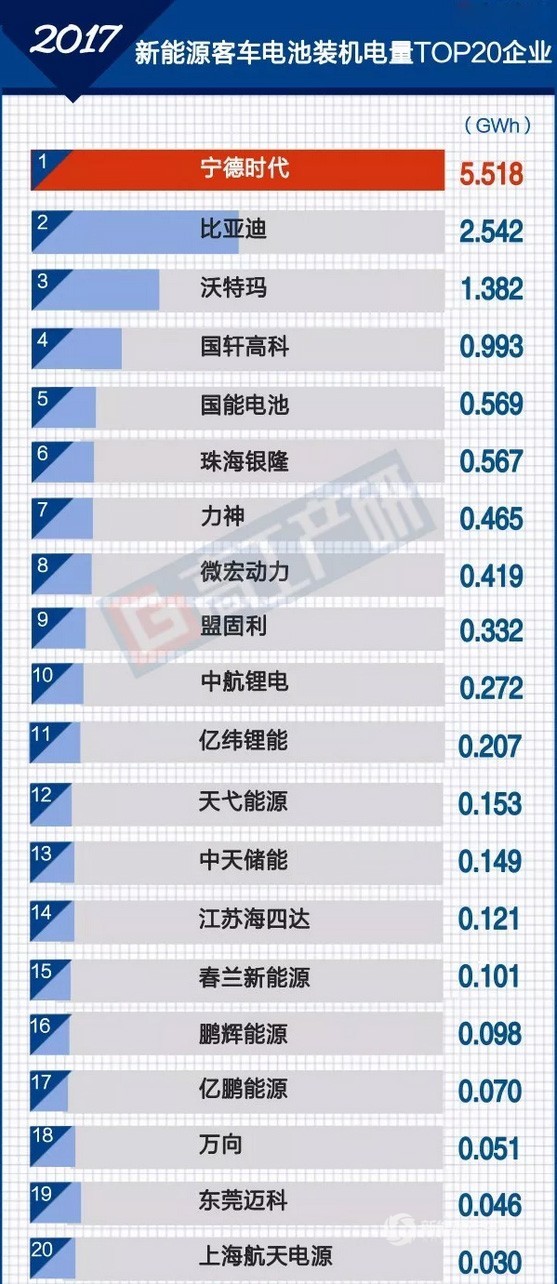
According to the data, the top ten enterprises in 2017 with total installed power of power batteries are Ningde Times, BYD, Watma, Guoxuan Gaoke, Bick Battery, Lishen, Funeng Technology, Yiwei Lithium Energy, Guoneng Battery and Zhihang New Energy. In 2017, the total installed capacity of power batteries was 36.24Gwh, Ningde era successfully won 1/3 of the domestic power battery market with an installed capacity of 10.4Gwh. BYD ranked second, with a total installed capacity of 5.43Gwh, accounting for 15% of the domestic power battery market. Statistics show that in 2017, China's new energy passenger car battery installed total power of about 13.71GWh, an increase of 50%. Among them, the top 20 power battery enterprises with total installed power reached 13.16GWh, accounting for 96% of the total, of which Ningde era was 4.112GWh and BYD was 2.904GWh. The total installed power of the above two enterprises accounted for more than 50% of the total, while the remaining 18 enterprises did not exceed 1GWh. In 2017, the total installed power of new energy bus batteries in China was about 14.31GWh, down 10% year on year. Among them, the top 20 power battery enterprises with total installed power reached 14.08GWh, accounting for 98% of the total, of which Ningde era was 5.518GWh, BYD was 2.542GWh, and Waterma was 1.382GWh. The total installed power of the above three enterprises accounted for more than 50% of the total, while the remaining 17 did not exceed 1GWh.
It can be seen that as the first camp of Ningde era and BYD's market share and total installed capacity accounted for nearly 50%, the top 20 power battery enterprises installed total power accounted for more than 96%, the new pattern of the industry settled, the industry concentration unprecedented increase.
In the power battery industry, BYD has always adhered to the layout of the whole industrial chain, covering 100% from upstream lithium resources to the development of main raw materials, to batteries, modules and BMS, including electronic systems and recycling. According to the data disclosed by BYD in November 2017, BYD's battery capacity will reach 16Gwh by the end of 2017, with 6Gwh of ternary battery capacity and 10Gwh of lithium iron phosphate battery capacity respectively. It is expected to add 10Gwh of ternary battery capacity in 2018, with the total capacity climbing to 26Gwh. According to BYD's plan, the planned production capacity will reach 39Gwh by 2020.
With the continuous increase of battery production capacity, BYD also regards this business as a new profit growth point. According to the national "13th Five-Year" development plan, by 2020, the production and sales of new energy vehicles will exceed 2 million vehicles in that year, and the cumulative production and sales will exceed 5 million vehicles. The rapid growth of market demand for power batteries in the future is an unchangeable trend. In the face of such market opportunities, Wang Chuanfu, who started with the battery business and became the "battery king" by virtue of independent research and development, obviously wants to maximize the potential of the battery sector.
Since May 2017, BYD's battery business has been split and operated independently, thus breaking the original vertically integrated production and operation mode and supplying power battery modules with core technologies to the entire new energy vehicle market. this means that competitors of BYD's electric vehicles may be equipped with BYD's batteries in the future. Recently, BYD's (01211.HK) investor relations activity record shows that as the company gradually opens up its supply chain system, the company will also sell batteries to the outside world in the future. At present, it has been talking with many vehicle manufacturers, and some batteries will be sold to the outside world as soon as 2018. It is reported that BYD will gradually increase its battery sales in the next few years.
If BYD, relying on power batteries, has embarked on a new journey of deep layout in the whole industry chain of new energy and moving towards a revenue scale of 1 trillion yuan, then the Ningde era, which focuses on deep cultivation in the field of lithium, has performed well in improving quality and reducing costs and changing market strategies.
There is no doubt that new energy passenger cars are the growth leader, and only by seizing passenger car customers can they achieve great development. Ningde Times's prospectus shows its big customers shifting from passenger cars to passenger cars. In the first half of 2017, its largest customer has changed from Yutong to Geely Holdings, and Xiamen Jinlong, the fifth largest customer, has been replaced by Dongfeng Motor. Timely card passenger car market, making Ningde era in the power battery system average price from last year's 2016 2.06 yuan to 2017 1.52 yuan in the first half of the case, gross margin is still maintained at 37.1. At the same time, cooperating with SAIC and Dongfeng Motor and other vehicle companies to build factories has also become a new way for lithium battery companies such as Ningde Times to become bigger and stronger.
Facing the trend of centralization in the power battery market, Waterma Battery has won a total of more than 10.3 billion yuan of orders since 2017 by virtue of the cooperation among members of its Waterma Innovation Alliance platform.
To sum up, the new energy vehicle network [xnyauto] analysis believes that with the intensification of the industry knockout, the power battery industry may have revealed the "oligarch era", and the Matthew effect of the stronger the stronger will become more and more obvious. Undoubtedly, in the next three to five years, my country's lithium battery industry will be deeply reshuffled. More than 90% lithium battery companies will be merged, reorganized or bankrupt. The number of companies that can truly enter the vehicle supply system will not exceed 20, and the production capacity will be highly concentrated. To the top few hands.
Undoubtedly, the lithium industry, which is experiencing pains, confusion and setbacks, is performing wonderful and helpless, and is also facing hope and light.
Next Page
Related News recommend
—
2025-03-07
Contact Information
Mailbox:info@zzdy.cn
Tel:0371-62138138
Fax:0371-62138138
Address:Automobile Industrial Park, South Section of West Ring Road, Zhongmou County, Zhengzhou, China
Quick Links
Keep in touch
Automobile Industrial Park, South Section of West Ring Road, Zhongmou County, Zhengzhou City
Mailbox:info@zzdy.cn
Landline:+86(371)62138138
Time: Week-to Saturday 8:00-17:00
online message
Integrity based on the market, quality dedication to society