Automobile Industrial Park, South Section of West Ring Road, Zhongmou County, Zhengzhou City





List of local subsidy policies for new energy buses in 2016
Release time:
2019-10-22
Source:
In the first quarter of 2016, a total of 6265 pure electric buses were produced, an increase of 84% year-on-year, but compared with the 365 increase in the first quarter of 2015, the growth rate in 2016 slowed down significantly. Entering the second quarter, subsidy policies in some regions are still not clear, and many companies are in a wait-and-see state. Entering June, local subsidy policies have been introduced one after another, and China Bus Network has sorted out the adjusted parts of the local policies that have been released.
Beijing:
Beijing stipulates that pure electric passenger cars will be subsidized for 25000, 45000 and 55000 respectively according to different driving ranges in 2016. In 2017, 20000, 36000 and 44000 will be subsidized respectively according to different driving ranges. Fuel cell passenger cars will be subsidized by 200000 yuan in 2016 and 2017. The total amount of financial subsidies applied by automobile production enterprises from the central government and this city shall not exceed 60% of the sales price of vehicles. If the total amount of subsidy is higher than 60% of the vehicle sales price, the amount of financial subsidy in this city shall be calculated after deducting the central subsidy from 60% of the vehicle sales price. On the basis of the central subsidy, Beijing's pure electric bus subsidy is determined according to the central standard 1:1, and the subsidy standard in 2017 will be reduced by 20% from 2016.

Shanghai:
1. pure electric bus

2. fuel cell

3. subsidies retreat

Note: S represents the total cumulative sales of this type of new energy vehicles by a single new energy vehicle manufacturer in this city since January 2014; TS represents the total cumulative sales of all this type of new energy vehicles in this city since January 1, 2016.
Henan Province:
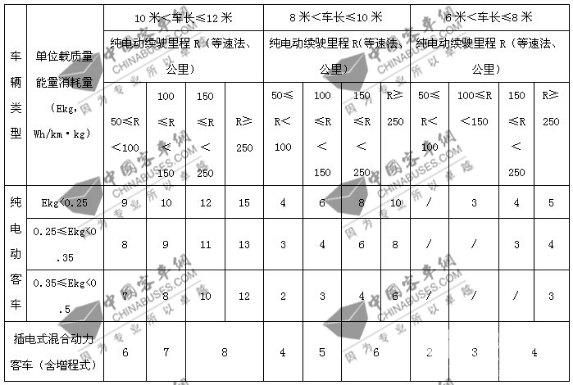
The types of subsidized vehicles include pure electric buses, plug-in hybrid (including extended range) buses, fuel cell buses, super capacitor buses, and non-plug-in hybrid buses. Among them, pure electric buses and plug-in hybrid (including extended range) buses are divided into three different subsidy levels according to the length of the car body. Pure electric buses are subsidized by 4-80000 yuan per year, and plug-in hybrid buses are subsidized by 2-40000 yuan per year. Fuel cell buses are subsidized by 60000 yuan per year, and super capacitor buses and non-plug-in hybrid buses are subsidized by 20000 yuan per year. as shown in the following table.

Jiangsu Province:
Jiangsu Province stipulates that the total amount of subsidies from local finance (including provincial and municipal finance) shall not exceed 60% of the selling price of the car after deducting the state subsidy (subject to the sales invoice), of which the provincial financial subsidy shall not exceed 30% of the selling price of the car after deducting the state subsidy. The municipal subsidy standard shall not be lower than the provincial subsidy standard. See the following table for details:
1. new energy bus
2. fuel cell bus

Nanjing City:
On June 16, 2016, the Nanjing Municipal Transportation Bureau issued a notice on the issuance of the 2016 Nanjing New Energy Vehicle Promotion and Application Financial Subsidy Implementation Rules. The notice shows that Nanjing plans to promote a total of 2502 vehicles in 2016, including 500 buses, 500 special vehicles of various types, and 1502 corporate and private passenger vehicles. The total number of new energy vehicle charging facilities is 3000, of which 2200 are AC piles and 800 are DC piles. The minimum subsidy standard for new energy buses is 20000 yuan and the maximum is 150000 yuan. In terms of fuel cells, passenger car subsidies 60000, light passenger cars, truck subsidies 80000, large and medium-sized passenger cars, medium and heavy trucks subsidies 100000. Basically consistent with the subsidy standards in Jiangsu Province.
Summary: Up to now, the local subsidy standards for new energy buses cover 8 provinces and autonomous regions in Jiangsu, Hainan, Shanxi, Hebei, Guizhou, Henan, Inner Mongolia, and Guangxi, Beijing, Shanghai, Shenzhen, Harbin, Xi'an, Haikou, Shijiazhuang, Changchun, 14 cities including Wuhan, Guiyang, Wuxi, Hangzhou and Nanjing. In the published subsidy standards for new energy buses, most cities have adopted the standard of 1:1 with the central government. Guizhou, Qinghai and Shijiazhuang, Hebei, subsidized at 1:0.5 with the central government. Haikou is subsidized at 1:0.6 with the central government. Guizhou, Wuxi and Nanjing in Jiangsu are subsidized at a ratio of 1:1 with the province.
Next Page
Related News recommend
—
2025-03-07
Contact Information
Mailbox:info@zzdy.cn
Tel:0371-62138138
Fax:0371-62138138
Address:Automobile Industrial Park, South Section of West Ring Road, Zhongmou County, Zhengzhou, China
Quick Links
Keep in touch
Automobile Industrial Park, South Section of West Ring Road, Zhongmou County, Zhengzhou City
Mailbox:info@zzdy.cn
Landline:+86(371)62138138
Time: Week-to Saturday 8:00-17:00
online message
Integrity based on the market, quality dedication to society